
Moving Targets
A Hand-Made Quilt Serves as a Primary Source for Genealogists

This post is one in a series about a “memory quilt” my mother made in 1990: twenty‑four embroidered squares that together form a visual record of my life, from birth through college graduation. If you’d like the full backstory on the quilt and this series, you can start here.
What These Squares Capture
Two of the quilt’s blocks trace the most dramatic geographic shifts in my early life: a leap to California before my first birthday and a later four‑year detour to Kansas. Together, they show how easily a family can vanish from the expected paper trail—and how something as unassuming as a quilt can hold the missing map.
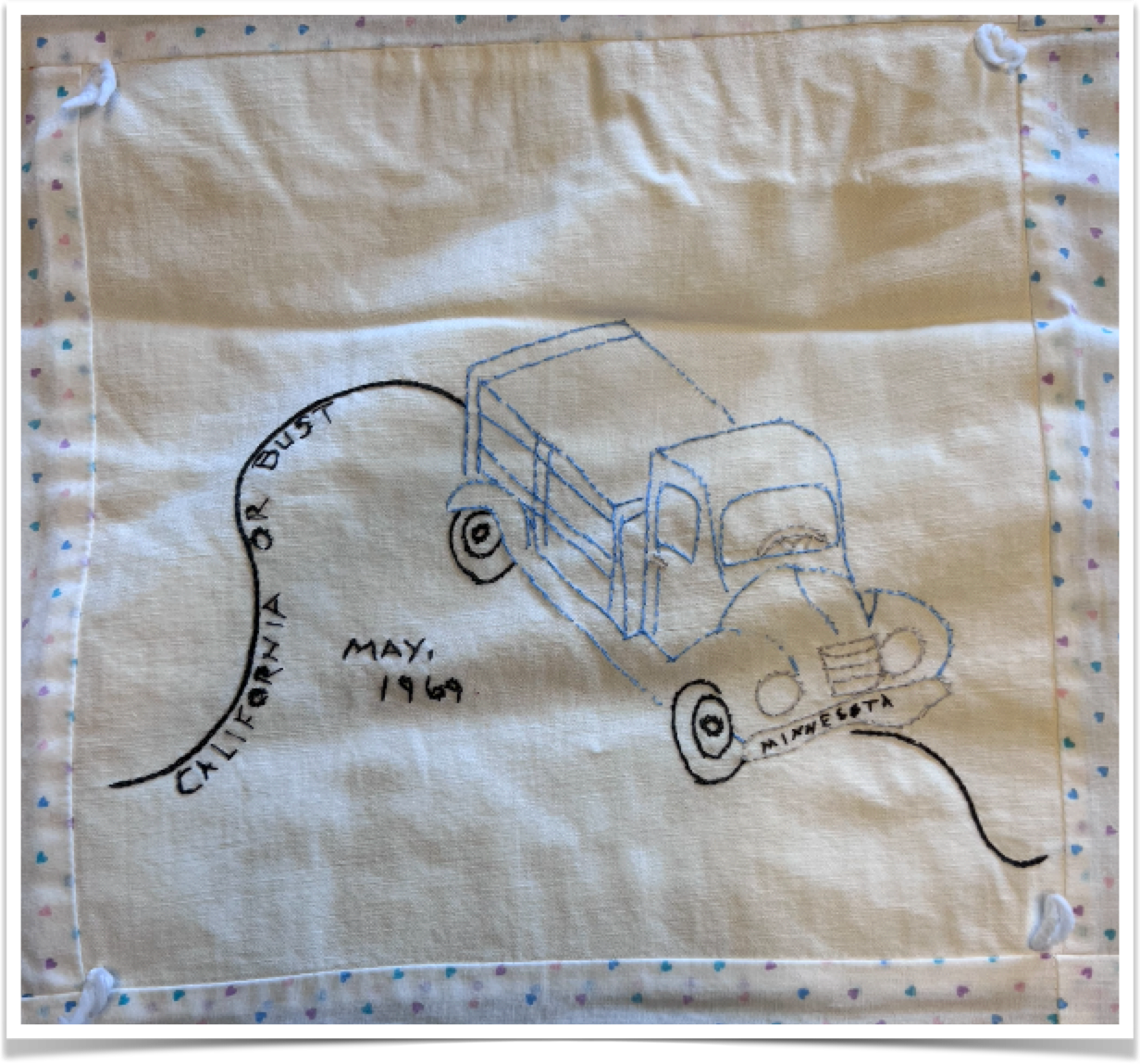
When I was not even one year old, my folks sold the few belongings they had, packed up their personal items, and drove us out to California to start a new life. They had gone there for their honeymoon and loved the weather. My dad had finished trade school as a printer and was seeking a job in a union shop. He turned down a few non‑union jobs in Minnesota and put his faith in the belief that once in California, the union would find him a job. Our stay in California was long enough to have another baby before an earthquake in early 1971 scared my parents right back to Minnesota.
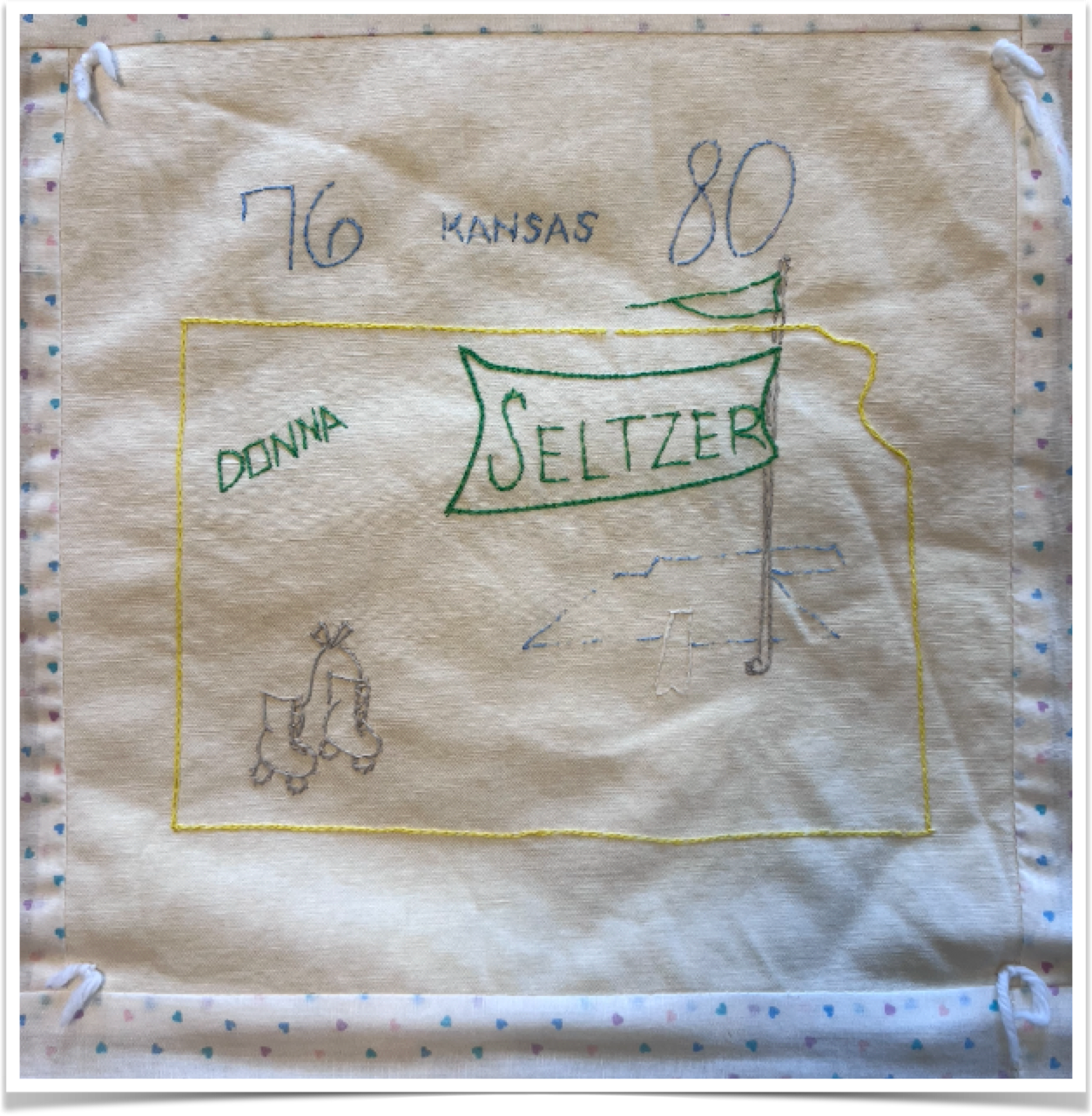
Within the outline of the state of Kansas, my mom stitched four elements that summed up that chapter of our lives. We lived there for four years when my dad was transferred. “Donna” is the name of the closest friend I had in Kansas. We kept in touch for a few years after our family moved back to Minnesota, but eventually lost touch. She and I lived nearby, and we attended Seltzer Elementary School. In the summer, we swam at the Moose Lodge’s swimming pool, and on Friday nights, we went to the roller skating rink—like most people of our age during this era. I’m glad these good memories are stitched into the quilt.
Viewed side by side, these two blocks remind me that big moves don’t always feel big in the moment. For my parents, they were acts of hope and necessity. For me, they became stitched timestamps: brief but important coordinates of a childhood that might otherwise blur into “we’ve always lived in Minnesota.”
How These Squares Have Aged
The California block has held up remarkably well. The thread is not as faded as it is elsewhere on the quilt. There is minor fraying, but the detail of the truck and its jaunty “California or Bust” message remains intact and easy to read.
The Kansas block shows a bit more wear. Some threads have faded or gone missing, but most of the details are still there—the state outline, the dates 1976–1980, and the key clues my mom chose to include.
Why These Squares Matter to Genealogists
For genealogists, these two blocks are a master class in why place matters and why it can be so tricky. When a family disappears from census records or local directories, it can be quite befuddling. When the 1970 census becomes available in 2042, my family will not be where we had been our entire lives up to that point. A casual researcher might assume the record is missing or mis‑indexed, but the quilt tells a different story: for a short season, we were in California.
The Kansas block offers a similar kind of clue. If a future descendant is trying to pinpoint our family and is not finding us in the expected Minnesota records, the stitched outline of Kansas—and the years 1976–1980—provide a valuable hint that the family had moved, and roughly when.
Together, these “moving target” squares show how a family’s path is rarely a straight line and how easy it is to misplace people when we assume they stayed put. A quilt like this encourages us to broaden our searches, follow every hint of an unexpected place, and pay attention to the small details that redraw the map of a life.
Have you ever lost a family in the records, only to discover they had moved somewhere unexpected? What non‑traditional clues helped you find them again?