
Verbal Heirlooms
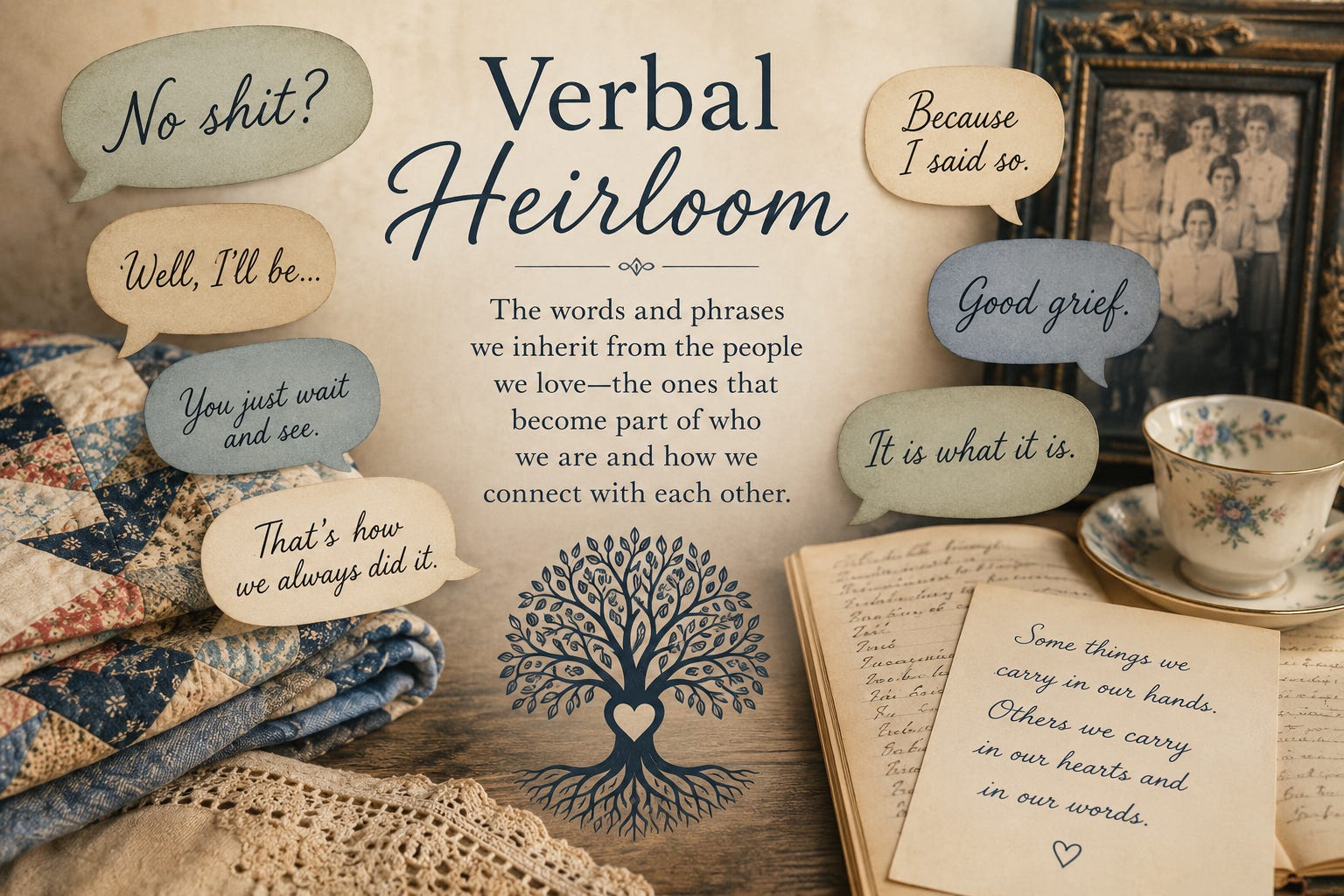
A family catchphrase has become one of my favorite inheritances

When we think of heirlooms, we usually think of physical objects—a piece of jewelry, a Derby hat, a recipe card in someone’s handwriting. Those things survive because someone intentionally kept them.
But families also inherit intangible things.
I’m not talking about inherited trauma or emotional legacies. I’m talking about words.
We inherit words. Not the language itself, of course, but the little pieces of it that become uniquely ours. Favorite expressions. Familiar responses. The phrases that tumble out before we’ve even thought about them.
AI told me they are (or should be) called “verbal heirlooms.” I like it.
Unlike Grandma’s wedding dress or a handmade quilt, you can’t fold them carefully into an archival box. They don’t hang in a closet waiting for the next generation. They survive only by being spoken.
Maybe that’s what makes them so precious.
Every time someone says one of those familiar family phrases, they’re preserving something that might otherwise disappear. It’s a tiny inheritance passed from one conversation to the next.
In my family, it’s this:
“No shit?”
Not “No shit!”—that’s a completely different creature.
The version with the exclamation point is sarcastic. It’s what you say when someone tells you the obvious.
“It’s really hot outside.”
“No shit!”
But the version I grew up hearing has a question mark attached to it. A rising inflection. Genuine surprise.
“You know they bought the old Johnson place?”
“No shit?”
Perhaps that’s why “No shit?” always makes me smile. It’s more than a funny expression. It’s part of my family.
I rarely say it myself, but I hear it often enough from my parents and my sisters that it’s become part of the soundtrack of our family. For reasons I can’t entirely explain, it makes me giggle every single time I hear it.
Curious where it came from, I did a little digging.
The expression “no shit” appears to have become common in American English sometime in the first half of the twentieth century, especially in military slang around World War II. At its core, it meant something like, “Really?” or “I’m serious,” depending entirely on the speaker’s tone.
And that’s what fascinates me. The words never changed.
Only the punctuation. One little rise at the end of the sentence transforms the meaning completely.
“No shit!” says, “Well, obviously.”
“No shit?” says, “You’re kidding!”
Same two words. Completely different conversation.
English does this all the time. “Really?” can express delight, disbelief, annoyance, skepticism, excitement, or concern depending entirely on how it’s said.
But “No shit?” somehow feels funnier.
Maybe because it’s unexpectedly earnest. It’s a slightly vulgar expression that sounds like a perfectly polite “Really?” It catches you off guard.
As genealogists, we spend enormous effort trying to recover the voices of our ancestors. We analyze letters, diaries, and official records, hoping to glimpse how they thought and spoke. Yet we often overlook the possibility that some of their language is still alive—not in documents, but in us. A phrase that your parents say without thinking may have come from their parents or grandparents, carried across decades with no one realizing it was being inherited at all. That’s a kind of heirloom that can’t be photographed, but it can still be recognized.
I’m not sure where my family picked up “No shit?”
I doubt I’ll ever know.
But every time I hear one of them say it, I smile.
No shit?
For years, I’ve been preserving the tangible heirlooms in my family—a Meerschaum pipe, a crackle glass perfume bottle, photographs, letters, and documents that tell our story.
Now I’m realizing there are heirlooms that can’t be folded into an archival box.
They’re carried in our conversations.
I’ve just begun listening for them.
Love this and it's inspired me to write a post about it! Well, so far I've just written it in the shower this morning after reading this!! Thanks. Love it!
What a wonderful way to think about family history. "Verbal heirlooms" is such an evocative phrase, and your story is a reminder that our ancestors live on not only through photographs and documents, but also in the words, expressions and little habits we inherit without even realising it. It certainly made me think about the sayings that have been passed down in my own family.